



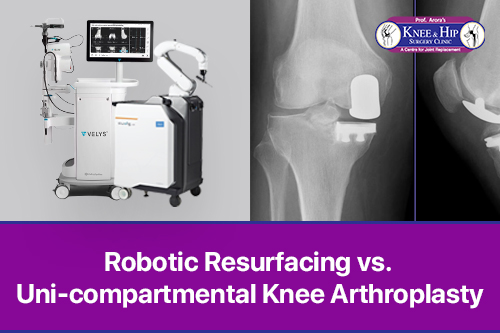
The knee is one of the most hardworking joints in the human body. Every step, squat, or climb depends on its smooth and coordinated movement. But when arthritis or injury damages the joint, simple activities can become painful and difficult. Fortunately, modern orthopaedics offers advanced solutions to restore comfort and mobility — among them, Robotic Resurfacing and Uni-compartmental Knee Arthroplasty (also called partial knee replacement).
Both these procedures aim to relieve pain and restore function, but they differ in how they are performed, who they are suitable for, and what recovery looks like. In this article, we’ll simplify the science and help you understand the key differences between Robotic Resurfacing vs. Uni-compartmental Knee Arthroplasty, so you can make informed decisions about your joint health.
What Is Robotic Knee Resurfacing?
Robotic knee resurfacing is an advanced form of knee replacement surgery that uses robotic technology to assist the surgeon in performing the procedure with remarkable precision.
In this technique, the damaged portion of the knee joint is carefully removed and resurfaced with an artificial implant. The robotic system creates a 3D model of the patient’s knee, allowing the surgeon to plan the surgery with extreme accuracy before even making an incision. During the operation, the robotic arm helps guide the surgeon’s movements, ensuring the implant is placed exactly as planned.
It’s important to note that the robot doesn’t perform the surgery independently — the surgeon remains in full control at all times. The robot simply acts as a highly intelligent assistant, improving precision, consistency, and safety.
Benefits of Robotic Knee Resurfacing
Unmatched Precision: The 3D mapping ensures implants fit perfectly, reducing errors.
Personalized Planning: Each procedure is customized to the patient’s unique anatomy.
Smaller Incisions: Less tissue damage and faster recovery time.
Improved Alignment: Perfect implant placement improves long-term knee mechanics.
Faster Rehabilitation: Patients typically return to normal activities sooner.
Reduced Pain and Blood Loss: Because of the minimally invasive nature of the surgery.
Robotic resurfacing is suitable for both partial and total knee replacements, depending on the extent of the damage.
What Is Uni-compartmental Knee Arthroplasty?
Uni-compartmental Knee Arthroplasty (UKA), or partial knee replacement, is a surgical option for patients whose arthritis or damage is limited to only one compartment of the knee — either the inner (medial), outer (lateral), or front (patellofemoral) section.
Instead of replacing the entire joint, the surgeon removes only the worn-out cartilage and bone from the affected compartment and resurfaces it with metal and plastic components. The healthy parts of the knee — cartilage, bone, and ligaments — are preserved. This makes the joint feel more natural compared to a total knee replacement.
Benefits of Uni-compartmental Knee Arthroplasty
- Smaller Incision: Usually done through a smaller cut than total knee replacement.
- Quicker Recovery: Patients often resume daily activities within weeks.
- Less Pain and Blood Loss: Limited surgical trauma means less postoperative discomfort.
- Natural Knee Movement: Since most of the knee structure remains intact.
- Shorter Hospital Stay: Many patients go home the same day or after one night.
However, UKA is suitable only for patients whose arthritis is confined to one compartment. If arthritis progresses later to other parts of the knee, a total replacement might become necessary in the future.
Contact with Dr. (Prof.) Anil Arora for Joint Replacement
 1.png)
Dr. (Prof) Anil Arora
Chairman & Head of Department
Orthopaedics & Robotic Knee & Hip Replacement, Max Super Speciality Hospital and Institute of Joint Replacement, Patparganj, New Delhi 110092, India
Chairman & Chief Surgeon, Prof. Arora's Knee & Hip Surgery Clinics, NCR
Education & Training:
- DNB in Orthopaedics from National Board of Examinations
- MS in Orthopaedics from Dr. SN Medical College, Jodhpur
Hospital: Max Super Specialty Hospital
Clinic: Prof. Arora’s Knee & Hip Surgery Clinics, Delhi NCR
Experience: 33+ Years
- Commonwealth Academic Staff Fellowship in Primary, Complex & Revision Joint Replacement Surgery: Royal National Orthopaedic Hospital - Stanmore, London (UK)
- Professor at University College of Medical Sciences & GTB Hospital, New Delhi
- Assistant Professor at Dr SN Medical College & Mahatma Gandhi Hospital, Jodhpur
- Senior Resident at University College of Medical Sciences & GTB Hospital, New Delhi
Specialty: Orthopaedic Joint Replacement (Robotic Knee & Hip Replacement) Max Super Specialty Hospital
About: Dr. (Prof.) Anil Arora, Guinness world record holder and Limca book of records holder, is a Senior Robotic Total Knee & Hip Replacement surgeon. He is an Internationally known figure in Orthopedics and joint replacement. He has been performing joint replacements since 1988, experience of more than 33 years and 12,000 Knee & Hip Replacement surgeries. Teaching in medical college and training Orthopedic surgeons has provided him with vast surgical and clinical experience and expertise. He has wide-ranging skills in knee and hip replacement surgeries. He is known for his sound clinical judgment and fine surgical skills. He was the first surgeon to start pinless computer navigated total knee replacements in north India. He is regularly performing primary, complex and revision (Robotic & pinless computer navigated) knee and hip replacement surgeries. He is also performing primary and revision elbow and shoulder replacements. He is the immediate past president of Delhi Orthopedic association.
Robotic Resurfacing vs. Uni-compartmental Knee Arthroplasty: The Key Differences
Now that we’ve covered both procedures, let’s explore how they differ — in technology, surgical approach, recovery, and outcomes.
Robotic Resurfacing vs. Uni-compartmental Knee Arthroplasty (UKA)
To know about ACL Reconstruction visit here: ARTHROSCOPIC ACL RECONSTRUCTION
Which Procedure Is Right for You?
Choosing between Robotic Resurfacing vs. Uni-compartmental Knee Arthroplasty depends on several factors:
- After Robotic Resurfacing: Patients are usually encouraged to walk the same day or the next. Physiotherapy starts early to restore motion, balance, and strength. Most return to normal activities within 4–6 weeks.
- After Uni-compartmental Knee Arthroplasty: Since only one section of the knee is replaced, patients often recover even faster — some resume light activities within 3–4 weeks. Regular physiotherapy ensures smooth movement and stability.
Both procedures have excellent success rates when performed by experienced orthopedic surgeons. However, robotic-assisted techniques provide an additional layer of confidence by eliminating much of the guesswork during surgery.
The Future of Knee Surgery
As technology continues to evolve, robotic knee surgery is becoming the new standard for joint replacements. The ability to precisely plan, execute, and verify every step of the operation leads to improved outcomes and higher patient satisfaction. Meanwhile, uni-compartmental arthroplasty remains a reliable, time-tested option for early-stage arthritis confined to one compartment.
Rather than seeing one as superior to the other, it’s best to understand that both serve different purposes. The right choice depends on your knee’s condition, lifestyle goals, and the advice of your orthopedic specialist.
Conclusion
When it comes to Robotic Resurfacing vs. Uni-compartmental Knee Arthroplasty, both procedures share the same goal — to relieve pain, restore mobility, and help you return to the activities you love.
Robotic resurfacing offers cutting-edge precision and is suitable for complex or multi-compartment damage. Unicompartmental knee arthroplasty, on the other hand, is ideal for patients with limited arthritis seeking a quicker recovery and a more natural knee feel.
Considering a Joint Replacement?
Get expert advice and world-class treatment from Dr. (Prof.) Anil Arora, a leading ROBOTIC Knee and Hip Replacement specialist in India.
Book Your Consultation NowLimited slots available – Take the first step towards pain-free living!
1.Extent of Arthritis: If only one section of your knee is affected, UKA may be sufficient. If multiple compartments are damaged, robotic resurfacing offers a better long-term solution.
2.Your Age and Activity Level: Active or younger patients often benefit from robotic resurfacing due to its precision and durability. Older patients with limited arthritis may prefer UKA for its simplicity and shorter recovery.
3.Desired Accuracy and Longevity: Robotic resurfacing provides unmatched accuracy, which may lead to longer-lasting implants and more natural joint motion.
4.Surgeon’s Expertise: Always choose a hospital and surgeon experienced in both robotic and conventional joint replacement procedures. Expertise plays a major role in surgical success.
Recovery and Rehabilitation
Recovery after either procedure is much quicker today than it was years ago, thanks to minimally invasive approaches and improved pain management.