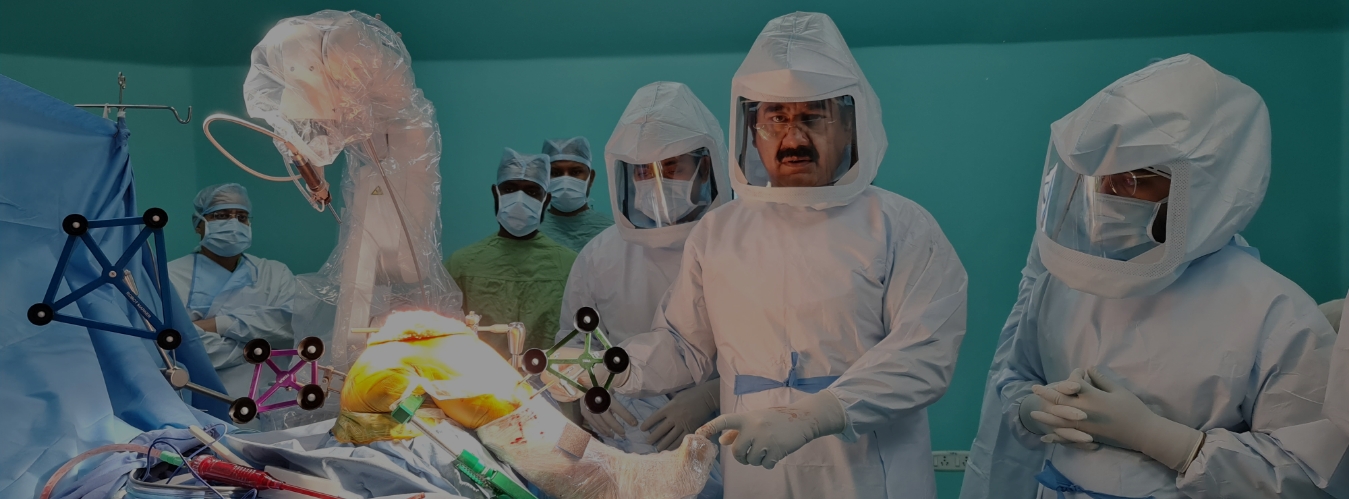


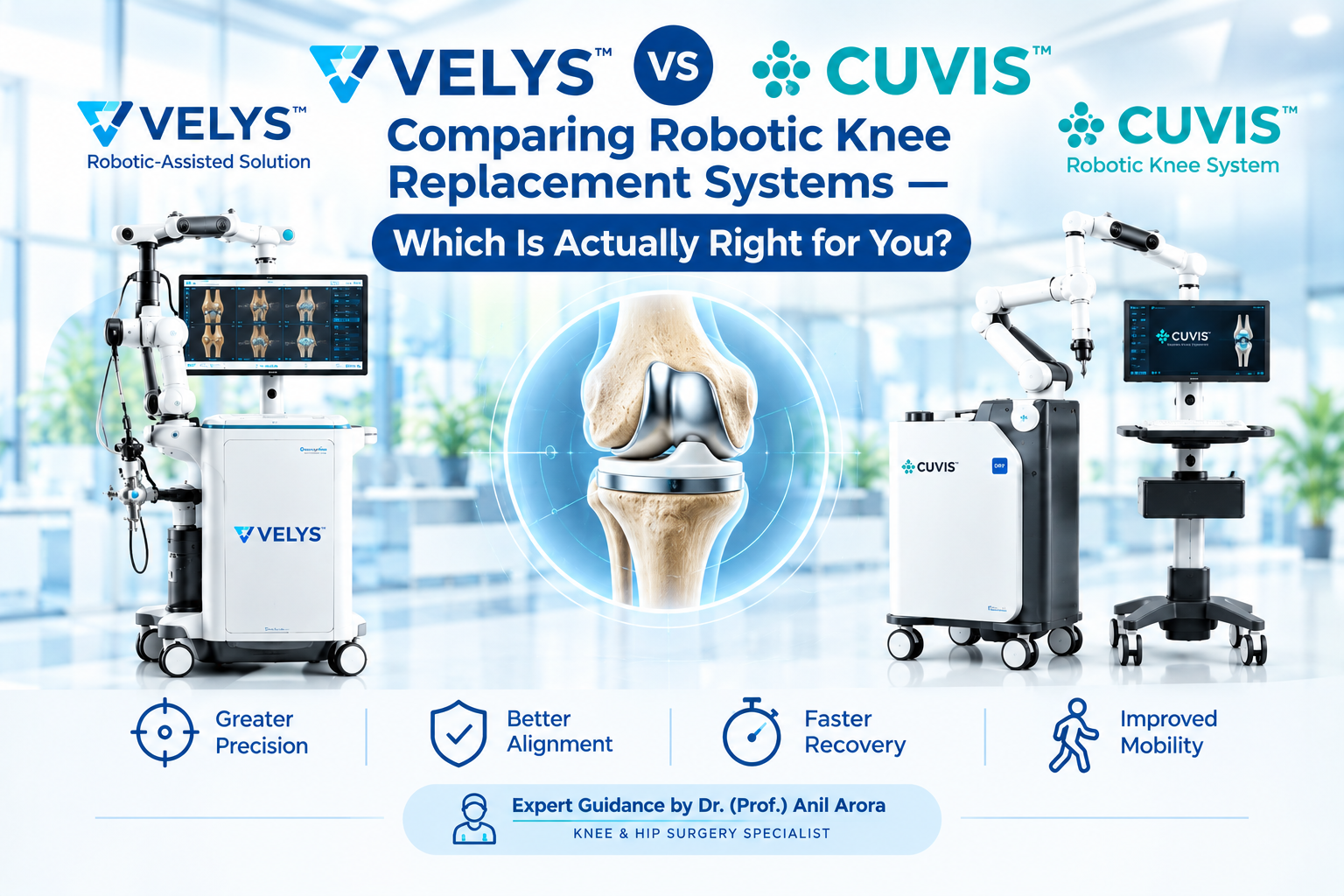
Short answer: Both are genuinely advanced robotic systems, but they work quite differently. VELYS is a CT-free, table-mounted system built exclusively for one implant brand; CUVIS is a CT-based system with an autonomous cutting arm that works across multiple implant brands. Neither is universally "better" — the right choice depends on your specific case and, more importantly, your surgeon's real experience with the system.
Patients ask me some version of "which robot is best" almost every week, usually after reading two different hospital websites, each confidently claiming their system is the superior one. Both are technically correct, and both are leaving out the parts that actually matter for a patient trying to decide.
So let's go through VELYS and CUVIS honestly, feature by feature.
What Is VELYS?
VELYS is DePuy Synthes' (Johnson & Johnson MedTech) robotic-assisted knee replacement system, and one of the newer entrants in this space.
Its defining feature: it's imageless, meaning it doesn't require a preoperative CT scan. Instead, it gathers precise measurements in real time, during the surgery itself, to guide bone cuts and implant positioning.
Key characteristics:
- Table-mounted design — integrated with the surgical table rather than a separate robotic arm
- No CT scan required, which means one less pre-op visit, no added radiation exposure, and a simpler scheduling process
- Semi-active system — the surgeon performs the actual bone cuts, with the robot providing real-time guidance and constraint to keep them within the planned parameters
- Works exclusively with the ATTUNE knee implant system — a closed platform, meaning no flexibility to switch implant brands
Early clinical data comparing VELYS to conventional manual surgery has shown shorter surgical time, improved early mobility, and shorter hospital stays — genuinely encouraging results, though the published research is still relatively limited given how recently the system launched.
What Is CUVIS?
CUVIS-joint is a robotic system developed by CUREXO in South Korea, distributed and supported in India by Meril Life Sciences. It's been in clinical use considerably longer than VELYS, with a track record across more than 100 hospitals worldwide and tens of thousands of documented procedures.
Key characteristics:
- CT-based system — requires a preoperative CT scan to build a detailed 3D surgical plan before you even enter the operating room
- Active, autonomous cutting arm — a 6-axis robotic arm that performs the actual bone resection based on the pre-built plan, rather than the surgeon making the cuts by hand
- Open platform — compatible with a range of different implant brands, giving surgeons more flexibility for complex or unusual anatomy
- Real-time gap-check function — even with a pre-built CT-based plan, the system allows adjustments during surgery itself
- Published accuracy data includes implant size prediction accuracy above 98%, and bone resection within roughly 1mm of the planned target
VELYS vs CUVIS: The Real Technical Differences
| Feature | VELYS | CUVIS |
|---|---|---|
| Pre-op imaging | Not required (imageless) | CT scan required |
| Cutting approach | Semi-active — surgeon cuts, robot guides | Active — robotic arm performs the cut |
| Implant compatibility | ATTUNE only (closed platform) | Multiple brands (open platform) |
| Physical design | Table-mounted | 6-axis robotic arm |
| Track record | Newer, growing evidence base | Established, larger published dataset |
Notice that this isn't really a "one is more advanced" story — it's two different design philosophies. VELYS prioritizes workflow simplicity and skipping the CT scan; CUVIS prioritizes detailed upfront planning and implant flexibility.
Does One Give More Accurate Results?
Honestly, both have shown strong precision data in their respective published research — but the comparisons aren't perfectly apples-to-apples, since they've mostly been studied against conventional manual surgery rather than head-to-head against each other in large trials.
What's more consistently true across essentially all modern robotic systems, VELYS and CUVIS included, is this: the precision of the technology matters less than how experienced the surgeon is with that specific system. A surgeon with hundreds of cases on one platform will typically outperform a surgeon with a handful of cases on a "more advanced" one.
Which One Should You Actually Care About?
Here's something worth being direct about: in practice, you usually don't get to pick the robotic brand independently — you choose a hospital and surgeon, and they use whichever system they're trained and equipped with.
So the more useful question isn't "VELYS or CUVIS" in isolation. It's:
- Does my surgeon have substantial experience specifically on this system, not just robotic surgery in general?
- Does the implant compatibility matter for my specific case — do I need a particular implant brand for a legitimate anatomical or medical reason?
- Am I comfortable with a pre-op CT scan, or is avoiding one genuinely important to me?
- What does the published outcome data actually show for this system at this hospital, not just the manufacturer's marketing?
Questions Worth Asking Your Surgeon
- How many procedures have you personally performed on this specific system?
- Why did your hospital choose this system over the alternatives?
- Does this system limit which implant brand I can receive, and does that matter for my case?
- What's genuinely different about my recovery process with this system versus a conventional approach?
Not sure which robotic system suits your knee?
Dr. Arora will walk you through the technology and the reasoning behind it, not just the marketing.
The Bottom Line
VELYS and CUVIS are both legitimate, well-engineered robotic systems built on different philosophies — one built around skipping the CT scan and streamlining workflow, the other built around detailed upfront planning and implant flexibility. Neither is objectively superior across the board, and the branding wars between hospitals often overstate the difference this makes for you personally.
I'm Dr. (Prof.) Anil Arora, and what I tell patients directly is this: the system matters less than the hands operating it. Ask about surgeon experience with the specific platform before you ask about the brand name on the machine.
Considering robotic knee replacement and want an honest walkthrough of which system fits your case? Book a consultation — we'll discuss the technology and the reasoning behind it, not just the marketing.
Every year you wait has its own cost.
Find out what's actually realistic for you — talk to Dr. Arora before deciding to keep waiting.



.png)